
Why the future of enterprise AI belongs to organizations that engineer context — not just prompts
Over the past year, we launched the early MVP versions of several AI-assisted niche publications and intelligence workflows.
Some worked well immediately.
Some exposed weaknesses we had not fully anticipated.
And some taught us an important lesson:
That realization forced us to slow down.
Not because AI failed. But because fluency is not the same as operational usefulness.
That distinction matters more than most people realize.
While much of the industry celebrated the idea that AI could generate entire businesses overnight, we invested nearly a year in R&D in our core platform to achieve hallucination-resistant and contextually-relevant AI, and the better part of past six months recalibrating the underlying platform architecture behind our publishing and intelligence systems.
Subscribe for thoughtful analysis beyond the hype cycle.
Today, much of the public conversation around AI revolves around prompting:
- how to ask better questions
- how to structure prompts
- how to chain prompts together
- or how to get a model to produce more polished output.
Prompting matters.
But in serious enterprise environments, prompting alone is not enough.
That means defining:
- what information matters,
- which sources are trusted,
- what constraints exist,
- what decisions follow from the answer,
- what tradeoffs matter,
- and what “good” actually means in that specific operational environment.
Without that context, even highly sophisticated models can produce answers that sound excellent while being operationally unusable.
That is the hidden trap many organizations are beginning to encounter.
- The model sounds intelligent.
- The output looks polished.
- The demo feels impressive.
But once the workflow reaches real pricing decisions, procurement decisions, risk analysis, forecasting, customer operations, or executive strategy, the gap becomes obvious.
AI fluency is not business utility.
And that is where context engineering begins.
Prompting is not the same as context engineering
A prompt is an instruction.
Context is the operational environment.
A prompt tells the model what to do.
Context tells the model:
- what matters,
- what does not,
- what constraints exist,
- what sources are authoritative,
- what risks are unacceptable,
- and what decisions depend on the answer.
That difference becomes critical in enterprise settings.
A commodity pricing workflow may depend on:
- which benchmark is contractually binding,
- which suppliers are approved,
- which regions are excluded,
- how stale data is treated,
- and what level of variance requires escalation.
A generic model does not know any of that unless the organization deliberately engineers that context around the system.
The same is true in procurement, finance, healthcare, publishing, legal operations, supply chain management, customer support, and strategic planning.
These are not simply “question-answer” problems.
They are decision-support systems.
A Simple Test
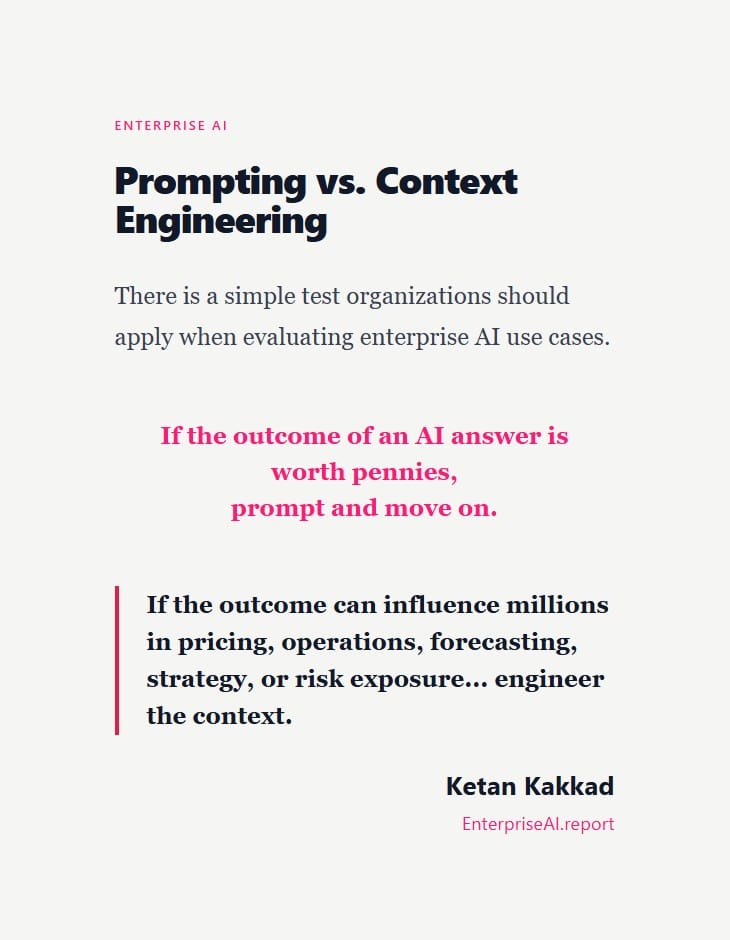
There is a simple test that organizations should apply when evaluating enterprise AI.
If the outcome of an AI answer is worth pennies, prompt and move on.
If the outcome can influence millions in pricing, operations, forecasting, risk exposure, customer strategy, or capital allocation, then a generic answer is no longer sufficient.
At that point, context engineering matters more than prompt engineering.
That distinction helps separate casual AI usage from operational AI systems.
You do not need elaborate context architecture for low-stakes tasks like:
- summarizing notes,
- drafting rough ideas,
- rewriting emails,
- or brainstorming headlines.
Basic prompting is often enough.
But when AI begins influencing business workflows with financial, legal, operational, or reputational consequences, the stakes change completely.
The goal is no longer to generate “an answer.”
The goal is to generate:
- a trustworthy answer,
- in the correct business frame,
- aligned with operational reality,
- and useful to a decision-maker.
The hidden difference between two organizations using the same model
Two organizations can use the exact same frontier AI model and achieve completely different outcomes.
The difference is rarely the model itself.
The difference is the context architecture surrounding the model:
- the retrieval strategy,
- the source hierarchy,
- the workflow design,
- the business rules,
- the decision framing,
- and the institutional knowledge embedded into the system.
One organization may treat AI like a chatbot.
Another may engineer it into a disciplined operational layer connected to trusted systems, curated data, workflow logic, escalation rules, and domain-specific intelligence.
The outputs may both sound fluent.
But only one becomes operationally useful.
That is the shift many enterprises are beginning to recognize.
The competitive moat increasingly moves away from access to the model and toward the quality of the context engineered around it.
Why enterprises often misunderstand AI value
One of the biggest misconceptions in enterprise AI is confusing linguistic fluency with business usefulness.
A model can produce a beautifully written answer that is completely unusable inside a real operational workflow.
That is because enterprise environments are filled with:
- exceptions,
- constraints,
- policies,
- dependencies,
- timing sensitivities,
- and business-specific judgment.
A polished answer without operational alignment is often worse than no answer at all because it creates false confidence.
This is where many early AI experiments struggle.
The demos succeed.
The pilots look promising.
But the moment the system interacts with real operational decisions, the limitations surface quickly.
The issue is not that the model lacks intelligence.
The issue is that the surrounding context was never properly engineered.
What context engineering actually looks like
Context engineering is not hype.
It is practical systems work.
It includes:
- curating trusted source material,
- structuring retrieval pipelines,
- prioritizing authoritative data,
- embedding institutional knowledge,
- defining role-specific behavior,
- enforcing workflow rules,
- designing escalation paths,
- maintaining attribution,
- and ensuring outputs map to real operational decisions.
In other words, it is the discipline of transforming a general-purpose model into a business-aware operational assistant.
That process is often far more important than the model itself.
Because in enterprise environments, usefulness rarely comes from raw intelligence alone.
It comes from disciplined context.
AI is not replacing expertise
The goal of enterprise AI should not be replacing human judgment.
The goal should be amplifying human judgment.
The best AI systems do not eliminate expertise.
They make expertise:
- faster,
- more scalable,
- more accessible,
- and more operationally efficient.
That only happens when organizations carefully engineer the environment in which AI operates.
The model may generate language.
But the business still defines:
- the mission,
- the priorities,
- the constraints,
- the governance,
- and the consequences of being wrong.
That is why context engineering matters.
It captures what the organization actually cares about and helps the system operate inside that reality.
Final thought
The future of enterprise AI will not belong to the organizations with the cleverest prompts.
It will belong to the organizations that build the best context around their systems.
Because in enterprise environments, the problem is rarely generating an answer.
The problem is generating an answer that is:
- trustworthy,
- explainable,
- operationally relevant,
- aligned to business reality,
- and useful inside a real decision-making workflow.
That requires more than prompting.
It requires engineered context.
And over time, that may become the single most important differentiator in enterprise AI.
Author Bio:
Ketan Kakkad writes about enterprise AI, contextual intelligence, and the systems required to make AI operationally useful in real-world environments.
He is the founder of AIForge and creator of TheNewsPublisher platform, where he explores how context engineering, workflow orchestration, and AI-assisted publishing can reshape decision-support systems and media intelligence.


