
There is a comforting, yet deeply dangerous, myth whispered across corporate IT departments: “Our security controls can be relaxed for internal applications because they sit behind the firewall.”
For decades, enterprise IT governance relied on established checkpoints. Before an internal application or operational dashboard ever reached production behind a corporate firewall, it had to pass through structured architectural review boards, code quality checks, and configuration compliance gates. Security was never ignored; it was built into the delivery lifecycle.
The explosion of generative AI development models like Claude and Cursor has shattered that timeline.
Today, mid-level managers and individual teams are using AI to instantly spin up highly functional internal tools—data migration scripts, prototype dashboards, HR utilities, or prompt playgrounds—in a fraction of the time it takes to log a request with centralized IT. Because these tools look complete and run strictly inside a corporate Virtual Private Network (VPN) or single sign-on (SSO) gateway, they frequently bypass traditional oversight mechanisms entirely.
This creates a severe governance gap. The threat is not that internal security standards are being intentionally abandoned, but that machine-speed development is actively outrunning the security gatekeepers. When unhardened, unreviewed "shadow utilities" land on an internal network with their frontend blueprints (Source Maps) active, they create an optimized roadmap for lateral network exploitation.
In the era of machine-speed development, unhardened internal enterprise apps have quickly become the primary target for advanced threat actors. The moment an organization relies on "inside the firewall" as its primary shield, it falls directly into the internal network trap.
Editor's Note: The Machine-Speed Risks Series
This article is Part 1 of a comprehensive, three-part investigation into the hidden security vectors of AI-driven enterprise development.
- Part 1:
Is Your Enterprise Better Prepared Than Anthropic? The Dangerous Reality of Vibe Coding. - Part 2:
This article: Bypassing the Gatekeepers: Why AI-Generated Internal Apps Slip Past Corporate Controls. - Part 3 (Members Only):
Coming soon: Guardrails for Machine-Speed Development: The CISO's Architectural Blueprint.
The Reality of Fluid Perimeters
The traditional concept of a hard network perimeter—a digital castle surrounded by a deep moat—is dead. Modern corporate networks are highly fluid ecosystems. Workstations are compromised via phishing vectors, supply-chain dependencies inject malicious code into developer laptops, and rogue browser extensions silently exfiltrate session data.
An attacker does not need to crack your server firewall directly. They only need to establish a single foothold on a standard employee's laptop inside your network.
Once an adversary is inside, the very first thing they perform is an internal network sweep to find proprietary apps. When they encounter an internal tool built via rapid "vibe coding" that still has its frontend blueprints (Source Maps) active, the fortress collapses from within.

Why Internal Apps House More Secrets
The danger of exposed source maps is compounded dramatically when an application is designed strictly for internal use.
When developers build public-facing cloud software, they are hyper-aware of external scrutiny. They know automated scanners will flag hardcoded credentials, and compliance mandates force them to isolate backend environment variables.
But when coding an internal tool meant to be seen by only five people in accounting, guardrails drop. Engineers regularly hardcode configuration properties directly into frontend code blocks to save time.
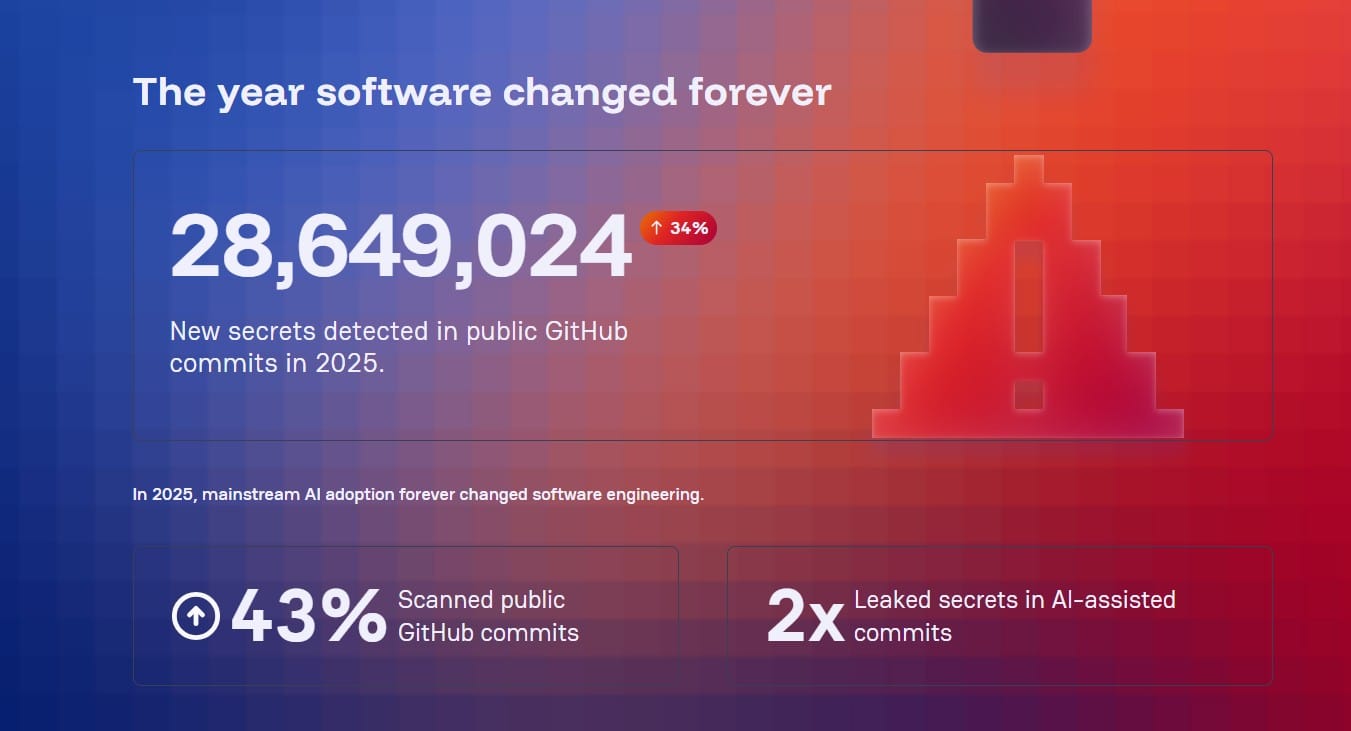
According to data compiled by security firm GitGuardian, internal enterprise repositories are actually six times more likely to house hardcoded infrastructure keys, database credentials, and private API variables than public repositories.
If an internal app exposes its .js.map source maps, an attacker on a compromised employee workstation can pull down the original, un-minified frontend source folder in seconds. They aren't just finding endpoints; they are finding the keys to the kingdom.
As the saying goes, "Encryption is Easy, Key Management is Hard". The advent of DevOps, cloud-native, and hyper-connected systems have all made the problem more acute than ever. - GitGuardian
The Authorization Blind Spot: Logic Gaps and IDOR
The risk is not merely structural; it is deeply logical. While generative AI models excel at spitting out clean, syntactically correct code blocks, they inherently lack an understanding of enterprise authorization hierarchies.
When an engineer asks an AI assistant to build an internal data-viewing portal, the model will faithfully construct the database queries and the frontend layout. However, it routinely misses deep backend authorization logic.
This oversight reintroduces classic, severe software flaws back into the corporate intranet—most notably Insecure Direct Object References (IDOR). Because the utility assumes anyone behind the firewall is trusted, changing a parameter in an internal URL string (like altering /api/user/101 to /api/user/102) often exposes sensitive data to users who have no right to see it. The AI builds the highway, but completely forgets to build the internal toll booths.
Oversight Dilution
Despite massive investments in cybersecurity, the velocity of modern development (fueled heavily by AI over the last year) is actively driving up human error and configuration neglect.
The Weaponization of Internal Blueprints
Consider how an automated, AI-driven lateral attack unfolds within a corporate intranet when an internal app is left unprotected, contains credentials in a deployed app, or exposes Source map as was the case with Anthropic' Claude Code source code leakage:
[Compromised Workspace] ──> [Scans Intranet for Apps] ──> [Extracts Exposed Source Maps]
                                                                     │
                                                                     ▼
[Lateral System Ransomware] <── [AI Maps Validation Gaps] <── [Exposes Hidden DB Schemas]
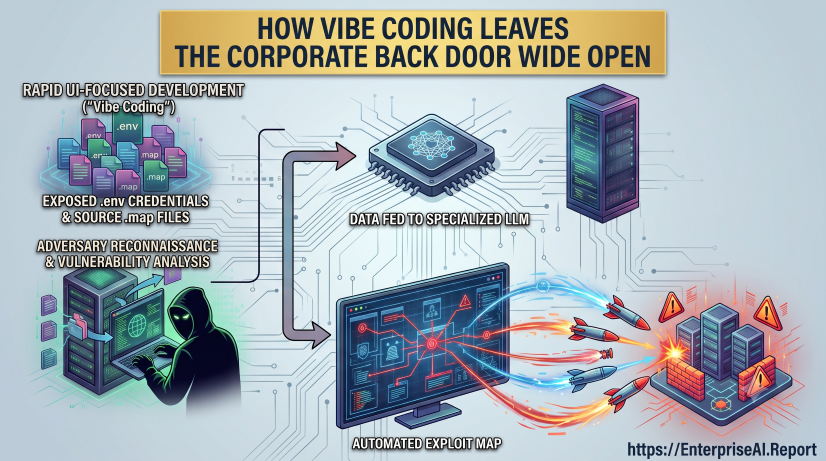
- Autonomous Asset Discovery: The adversary's script crawls your internal subnets, identifying web interfaces.
- Blueprint Extraction: It checks for .map extensions on internal JavaScript bundles. If found, it reconstructs your proprietary internal tooling code.
- AI-Driven Target Analysis: The code is processed by an LLM to find structural validation flaws. The AI looks at exactly how the internal app formats administrative data queries.
- Data Exfiltration and Ransomware: Because internal apps rarely implement robust input sanitization, the attacker uses the blueprint map to execute localized SQL injection attacks or forge API commands, executing lateral movement to compromise server infrastructure.
Granular Evidence: The Football Australia Exposure
While public-facing, the recent high-profile security oversight at Football Australia perfectly demonstrates the lethal longevity of frontend credential negligence. Due to an overlooked repository configuration, raw administrative AWS access keys were hardcoded into the public frontend framework layout.
Because the team lacked strict structural build auditing, those keys sat completely open to the browser for over 700 days.
In an internal corporate context, a vulnerability like this can sit silently for years. If a vibe-coded internal tool exposes administrative paths or internal database properties via source maps, it acts as a ticking time bomb waiting for an internal endpoint compromise to trigger it.
The False Security of VPNs
A VPN or an SSO portal is merely an identity checkpoint; it is not an application firewall. Once a user or a compromised device is authenticated past that gate, the application itself must be completely self-defending. Leaving internal tools unhardened because they live "inside" is the equivalent of locking your front door but leaving the safe wide open.
Relying on machine speed to build software requires implementing machine-speed verification.
In our final installment in this series, we will shift away from the threat vectors and hand corporate leaders the concrete architectural solution. We will deliver the definitive CISO Blueprint—explaining how to cleanly execute high-velocity AI development while enforcing continuous pipeline guardrails that keep your source code completely invisible to the world - even within your corporate network.
Unlock the Full Investigation
Secure your engineering pipeline. Part 3: The CISO's Architectural Blueprint will deliver actionable scripts, build flags, and pipeline strategies to eliminate this risk permanently.



A Case of Misconfiguration and Inadequate Change Control
Images credit: Julio Lopez | Arlington Research | Zulfugar Karimov


